


Self-locking nuts, also known as lock nuts, mainly include three types: all-metal self-locking nuts, non-metallic insert self-locking nuts, and metal clip self-locking nuts. All-metal self-locking nuts can be further divided into two subtypes: one is the three-point riveted end face type, which forms locking characteristics by slightly affecting the thread pitch; the other is the opposite side extrusion deformation type, which transforms the end thread from a circular shape to an elliptical shape to achieve the locking function. The impact of the friction coefficient on the final preload has been widely recognized and valued, but many people still have doubts about how to design the tightening torque for self-locking nuts. Today, the editor from Jiangsu Jinrui will discuss this issue with you.


1. Description of Torque for Self-Locking Nuts in VDI 2230
The VDI 2230 standard clearly states the tightening torque for self-locking nuts: when determining or calculating the tightening torque for such components, in addition to the conventional thread tightening torque (MG) and bearing surface tightening torque (MK), it is also necessary to consider the thread running-in torque (MU, exclusive to self-locking nuts) and the additional bearing surface resistance torque (MKzu, such as in the tightening scenario of toothed bolts/nuts).

However, the standard supplements that for high-preload fastener assemblies, the thread running-in torque (MU) can be neglected. This means that when the bolt is tightened to a high-preload state, MU does not need to be included in the total torque. However, the standard does not further clarify what constitutes "high preload" or how to define and measure it.
2. Measured Friction Coefficient of Lock Nuts
Taking nylon insert self-locking nuts as the test object, relevant issues are explained only through nut tightening operations. Their torque-angle and axial force-angle curves show that lock nuts have an obvious running-in torque stage: when the bolt is screwed into the nut until it touches the locking part, a specific running-in torque (i.e., anti-loosening torque) is generated; after the bolt thread completely passes the locking part, the running-in torque enters a stable stage and no longer continues to rise; when the nut is fully attached to the connected component, the torque increases proportionally with the rotation angle.

In the running-in torque stage, the bolt's axial force is basically zero, and the curve is roughly a horizontal straight line-which means the tightening torque displayed at this time has not been converted into effective preload. From the thread friction coefficient-angle and total friction coefficient-angle curves, it can be seen that the friction coefficient changes with the tightening angle: after the nut is attached to the connected component, the thread friction coefficient and total friction coefficient decrease as the axial force (or rotation angle) increases. This indicates that when the tightening torque of the lock nut is low, it cannot be set or calculated according to the conventional torque-axial force relationship; instead, it is necessary to use the actual friction coefficient or consider the running-in torque to be consistent with the actual working conditions.
The bearing surface friction coefficient of lock nuts changes slightly: after the nut is attached to the connected component, its bearing surface friction coefficient is basically consistent with that of ordinary non-locking nuts, and there is no significant fluctuation with the increase of preload (bolt axial force).


If the lock nut is developed according to the set friction coefficient, it can be tightened according to the conventional tightening torque during normal operation, and there is no need to additionally consider the running-in torque. This is because the friction coefficient test of lock nuts is carried out under the condition of 75% proof load, and the actual friction coefficient can meet the development requirements when tightened according to the conventional tightening torque. Test results show that when the lock nut is tightened to 1600℃, the thread friction coefficient is basically stable-at this time, it reaches about 50% of the final preload, and the thread friction coefficient is basically consistent with the final friction coefficient, maintaining a stable state.
Based on this, it can be clarified that if the designed preload of the self-locking nut reaches 40% of the bolt's proof load or more, there is basically no need to consider the running-in torque; the "high preload" mentioned in the VDI 2230 standard should be at least 40% of the proof load. If the designed torque is too low, the running-in torque of the self-locking nut needs to be included.
In addition, it should be noted that for fasteners with teeth on the bolt head or nut bearing surface, the VDI 2230 standard does not specify scenarios where the additional torque can be neglected-meaning such toothed fasteners need to consider the additional torque under the head/bearing surface in all cases. This is because when toothed fasteners are tightened, their friction coefficient (or equivalent friction coefficient) gradually increases; especially under high preload, the equivalent friction coefficient rises significantly, which is equivalent to the bolt head/nut bearing surface exerting an extrusion and scoring effect on the surface of the connected component.
3. Scenarios Where the Running-In Torque of Lock Nuts Needs to Be Considered

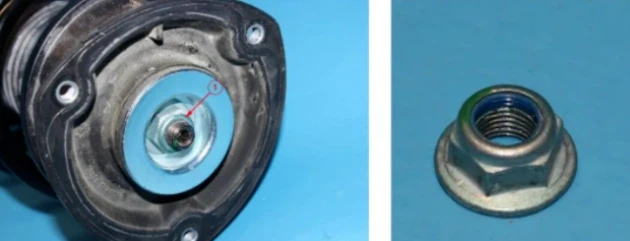
For example, in the connection scenario between the piston rod of a shock absorber and the mounting base (mount): to reduce weight, the outer diameter of the piston rod is usually not designed to be too large, and the effective bearing surface size is often only about 3mm, or even smaller in some designs. Therefore, on the premise of meeting various service requirements, the tightening torque of the mounting nut cannot be set too high-otherwise, excessive torque may easily cause crushing or permanent plastic deformation of the mounting base, leading to preload attenuation. From the perspective of force requirements, no excessive clamping force is needed here to withstand external loads, so the tightening torque of the nut at the top of the shock absorber is usually low. Taking a nut with a thread specification of M14×1.5 as an example, its tightening torque is often only about 60Nm. However, the maximum standard running-in torque of an M14×1.5-10 all-metal self-locking nut is 31Nm. If the actual running-in torque is close to this value, when tightened at 60Nm, the effective clamping force may decrease. Therefore, determining the friction coefficient of the self-locking nut is crucial in such low-torque design scenarios, and the impact of running-in torque must be emphasized.


